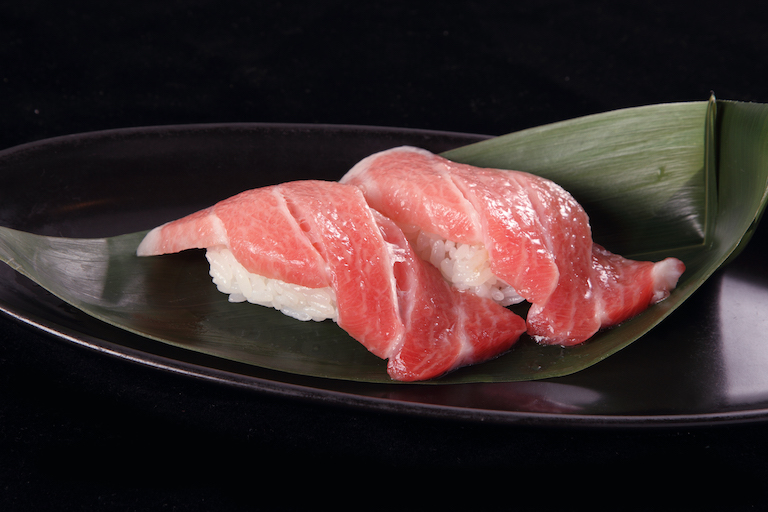
Tuna parts can mainly be divided into two: the fatty section known as Toro and the other part called Akami (red flesh).
Although Toro can be further subdivided, the highest fat content is in Otoro (Tuna belly) and Akami, and Chutoro (Tuna mid-belly) which is a mix of Akami and fat, can be considered as the representative parts of Toro.
Typically, Otoro refers to the belly near the head of the tuna, while Chutoro refers to the meat on the tuna's back and abdomen, but in reality, there's no clear distinction between Otoro and Chutoro.
Recently, Akami is priced over twice that of Chutoro, making it a popular sushi ingredient. However, in ancient Japan, people consumed Akami, and Toro was discarded.
In ancient Japan, people preferred a cleaner taste, and because refrigeration and distribution technologies were not developed, the fatty Toro easily deteriorated in taste.
During the Edo period, it was even called a fish that even a cat wouldn't touch, implying that cats would simply pass it by.
As the Japanese palate evolved and refrigeration technology developed, Toro gradually gained its current popularity.
The term "Toro" originates from the Japanese word "とろける", meaning "melt".
In 1918, the old sushi shop "Yoshinozushi" in Tokyo began calling it "Toro", which then spread and settled nationwide. Before that, because it was a fatty part, it was called "Abu" (oil), taken from the term "脂" for fat.